Jacquie Meng, Madeline Cardone, Cathy Zhang, Shen-Ju Hsieh, Bronwyn Sargeson, Allison Barnes, Sanne Carroll, Maddie Hepner, Natasha Pidcock, Roslyn Hall, Toni Hassan, Wendy Dawes, Sarah Murray, Miriam Penrose, Sophie Dumaresq and Lucy Chetcuti
Read More𝟮𝟬𝟮𝟭 𝗠𝟭𝟲 𝗗𝗿𝗮𝘄𝗶𝗻𝗴 𝗣𝗿𝗶𝘇𝗲 / by Exhibitions

Image: Melody Spangaro, Cadgewa, 2020. Graphite on plastic, 136 x 175 cm. Winner of the 2020 M16 Drawing Prize ($5000).
Gallery 1
26 November - 10 December 2021
The M16 Drawing Prize is an annual exhibition, focussing on works that utilise traditional or contemporary drawing materials and techniques. The prize and associated exhibition seeks to examine, challenge and open up a dialogue around the possibilities of drawing? It attracts interstate and international entries, and 2021, it will be in its 16th year. All works must be produced in the year prior to the exhibition.
This year all entries will be eligible for the online exhibition unless otherwise notified. Selected finalist will be displayed in Gallery 1, 26 November to 11 December.
2021 Finalists

Sold Out
Quick View
A$950.00
Pencil on paper, 15 x 100 cm (fully extended).
In a series of moments depicting the evening of April 29, 1881, 'Otara Reef' relays the wrecking of the SS Tararua on a rough, lonely edge of the Caitlins, in Southern New Zealand. Watson is descended from Susanna Paddon, a woman who was only recognised posthumously for her part in the rescue. Through this work Watson tries imagine the night that drastically changed a little seaside community, and ultimately her family, for generations. Charlotte Watson is a visual artist and writer whose work expands across drawing, printmaking and installation. Her work looks at the stories that inhabit a place, and how place inhabits us. She graduated from the University of Canterbury (Ōtautahi Christchurch, NZ) with a BFA in Sculpture in 2011 and is currently based in Narrm Melbourne.
Collection of the artwork from M16 is the responsibility of the purchaser.
Contact the M16 Office for more information on (02) 6295 9438.

Sold Out
Quick View
A$600.00
Photograph (of a drawing performance), 84 cm x 120 cm.
This work was a site-specific performative drawing piece. It was made in a public space, is time based, and uses the body and the environment to generate a drawing that describes process. It created no environmental impact in the drawing event and used materials from around the home. Gardening tools and plastic bottles were tied onto a climbing harness with string. The harness was worn, and these tools became an extension from the body to explore ways of mark making. The tools dragged behind the body, leaving marks in the sand as I walked on the beach. This performance explored the body as drawing tool, body extensions, and creating a live drawing, while being mindful of reducing environmental impacts through the art making process. In 2019 I was Artist in Residence at the Draw to Perform residency program in the United Kingdom. This work is influenced by this experience, where I was able to combine my two best friends: drawing and performance art. Since this residency I continue to develop the practice of performative drawing and explore how it can be used in a range of environments and how different marks can be made through this inter-disciplinary methodology.
Collection of the artwork from M16 is the responsibility of the purchaser.
Contact the M16 Office for more information on (02) 6295 9438.

Sold Out
Quick View
A$8,000.00
Charcoal on paper, 115 X 65 X 15 cm.
My practice is anchored in the suburbs, depicting the urban aesthetic which shape and inform our everyday lives. In this drawing, I look closer at suburbia focusing on an ordinary window cropped to the point where only the window dressings are on view. I aim to extract the sense of humanity that emanates from lived-in spaces, by reinterpreting and reinvigorating inhabited environments, accentuating attributes of life and longevity, beyond physicality. This drawn curtain signifies human existence and is the opening between reality and illusion, becoming the space for the imagination and an invitation to view the mundane with fresh eyes.
Collection of the artwork from M16 is the responsibility of the purchaser.
Contact the M16 Office for more information on (02) 6295 9438.

Sold Out
Quick View
A$2,000.00
Mixed media and projection, 20 x 160 cm
Wish You Were Here re-imagines liminality as a bizarre world of uncertainty where the order of things becomes caught in a state of suspended animation. In search of progress, multiple figures attempt to travel, yet go nowhere in an oddball world of absurdist collage. Individuals are in emotional and physical balancing acts as uncanny household objects collide within undefined landscapes. Stealing its title from Pink Floyd’s introspective track, Wish you were here this work is a visualization of my experience of being the a primary carer. Here figurative and abstract forms gently smash together in an experimental drawing of collage, paper, projected video and pencil on wall drawing. Through repetitive rhythm, tangled lines, monotonous loops, non-specific locations and an unspecified time, this work blends the physical and the psychological for a moment of hypnotic but reprieve. This work realizes an emotional balancing act experienced when holding space for someone sick and possibly nearing the end their life. As a female, often the unpaid and unacknowledged labor associated with the responsibility of care for family is both accepted and expected. For me, as I cared for my father, a surreal world of endurance ensued as I tried to manage emergencies, hospitals, jobs and my life in a suffering gig economy during COVID. The potential for loss of self was imminent. This psychedelic, playful and absurd drawing installation is a futile call for assistance as an individual continually attempts to hold emotional space?
Collection of the artwork from M16 is the responsibility of the purchaser.
Contact the M16 Office for more information on (02) 6295 9438.
Sold Out
Quick View
A$2,500.00
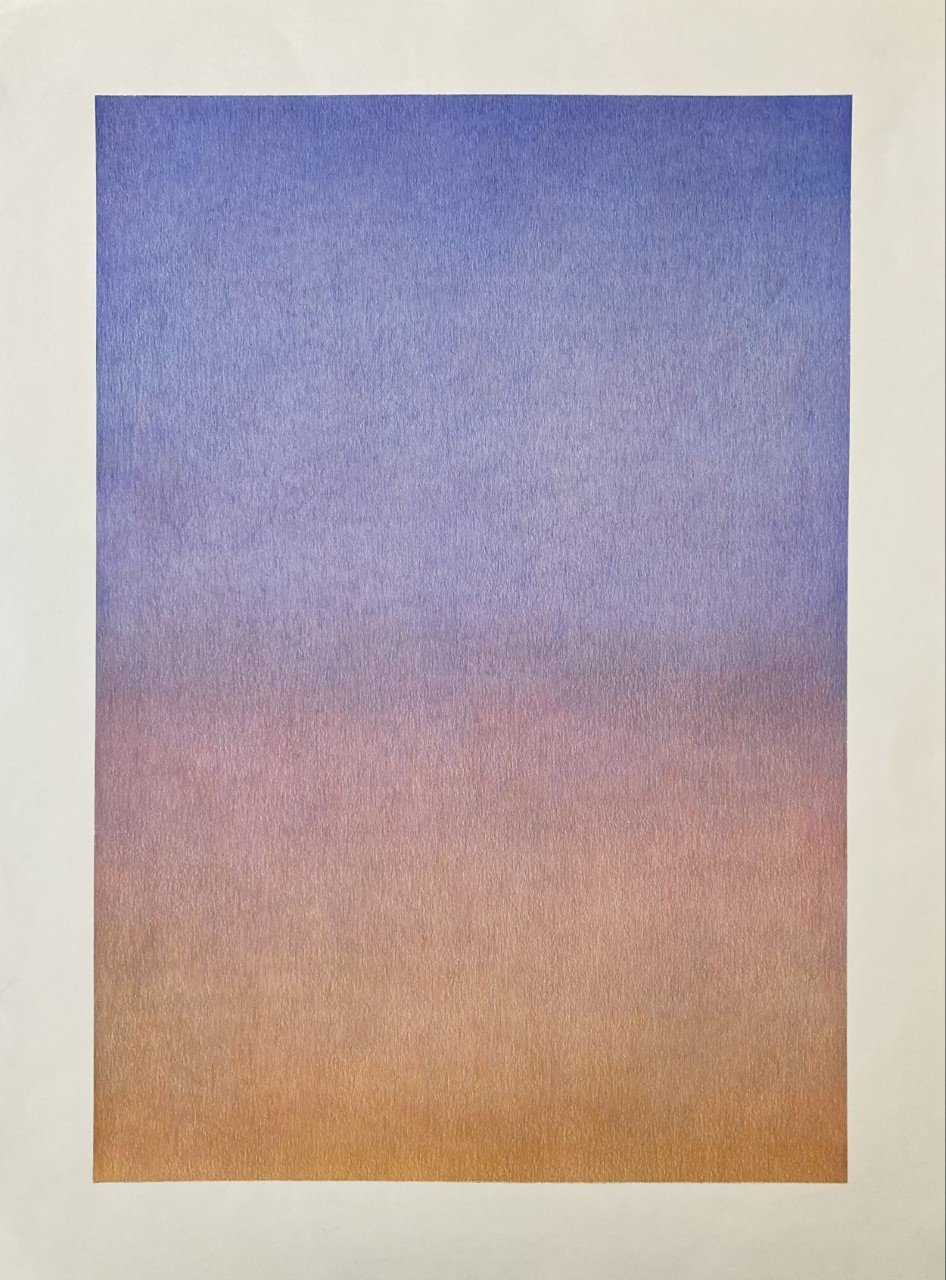
Coloured Pencil on Paper, 76 x 57 cm.
Jacqueline Rolston is a Perth-based artist creating works across painting and drawing mediums. Process and endurance are fundamental themes of Jacqueline’s practice. Her meticulously created coloured pencil drawings are created through a repetitive and time-intensive process of layering colour. Jacqueline’s work extends the concept of what drawing can be within a contemporary art practice. Inspired by the Western Australian morning and evening skies, Jacqueline looks to capture the fleeting and transient nature of light and colour, drawing attention to the moment of observation.
Collection of the artwork from M16 is the responsibility of the purchaser.
Contact the M16 Office for more information on (02) 6295 9438.

Sold Out
Quick View
A$2,500.00
Ink on card, 132 x 200 cm.
This work is comprised of seventy drawings made over the past four months, which were spent in and out of multiple lockdowns.
Visual priority is given to the shapes and surfaces of found cardboard, the austere palette, and the lo-fi immediacy of permanent marker.
This visual harmony exists in stark contrast to the sense of tension generated by experiencing numerous conflicting sensations at once.
Big feelings jostle with glib one liners. Glamorous fantasies meld with tedious daily experiences. Acerbic camp is mixed with loneliness and fragility.
Encapsulating a unique Queer sensibility, this work was made in the tradition of other queer artists who use text, particularly David Robilliard, Tracey Emin, Rene Ricard, A.L. Stiener, and David McDiarmid.
Collection of the artwork from M16 is the responsibility of the purchaser.
Contact the M16 Office for more information on (02) 6295 9438.

Sold Out
Quick View
A$2,500.00
Pencil on 360gsm Khadi Paper, 56 x 56 cm.
Beneath Our Feet is a suite of drawings which began as a diary of my residency at Cité Internationale des Arts Paris. Inspired by Guy Debord’s, psychogeography; a flaneur-like psychological exploration of the urban environment through free play of movement and discovery, and set against the city's historical background, the works reference the network of cracks within pavements once travelled and roads once taken. Until the mid-nineteenth century, the winding streets of Paris were paved with cobblestones. Haussmann’s redevelopment paved over the cobbles; enabling smoother wheeled travel, but also, a defence against citizen uprisings which had previously used the cobbles as weapons against the state.
Drifting aimlessly through this unfamiliar city, guided only by a street level gaze upon visually discarded details of the local everyday, the pavement cracks looked like re-imaged city street maps or anatomical drawings of arteries and veins. Simultaneously presenting micro and macro views, they act as a metaphorical journey of the life of Paris.
Collection of the artwork from M16 is the responsibility of the purchaser.
Contact the M16 Office for more information on (02) 6295 9438.

Sold Out
Quick View
A$300.00
pastel, pen and ink and charcoal on paper, 24 x 30 cm.
The first entry is a that of a dust storm at Mildura and the resilience of the community, which is the Australian way.
The second entry is a person who is dead tired and hiding under the covers of her bed, which is a reflection of the many lockdowns suffered these past two years.
Collection of the artwork from M16 is the responsibility of the purchaser.
Contact the M16 Office for more information on (02) 6295 9438.

Sold Out
Quick View
A$5,500.00
Ink, charcoal and pastel, 105 x 56 cm.
Drawing forms the core of my practice as I explore our complicated relationship with the natural world. Interwoven with this are themes of ecological grief and anxiety associated with climate change, our interdependence and accountability towards the environment, and our vulnerability and insignificance in the face of nature’s vastness and resilience.
My drawings are based on photographs I take of myself immersed in the landscape. Inspired by a background in dance and theatre, I undertake solitary performances witnessed only by a remote-controlled camera. These ‘performances’ are unrehearsed, spontaneous physical reactions to the topography around me. They become an act of endurance, or a private moving meditation that oscillates between awe, discomfort, melancholy, tenderness and solace.
'Nothing Happened Today' is a response to the overwhelming feelings of anxiety I have felt over the past two years. Heightened by the Black Summer of catastrophic bushfires, it escalated when – as the smoke had barely cleared - we were swept into a global pandemic that was dizzying in its speed and scale. Like a hostage with Stockholm Syndrome, I’ve become addicted to the news cycle while simultaneously being aware that it is not good for my emotional state. I almost forget what it’s like not to be bracing myself for numbers and graphs every morning, or dire warnings about temperature rises and species lost to extinction, and yearn for a day when there is no news to report.
Collection of the artwork from M16 is the responsibility of the purchaser.
Contact the M16 Office for more information on (02) 6295 9438.

Sold Out
Quick View
A$1,400.00
Handbuilt Etched Porcelain and Graphite, 10.5 x 18.5 x 6.5cm.
Artist Statement – Debbie Hill Listen Up and Protest Ark#1 from the Ark Series, are a response to the devastation of our ecosystems. The ark is a representation of the ecological ‘islands’ that are home to some of our most critically endangered species. I utilise porcelain to demonstrate the fragility of the environment and graphite to draw attention to the species on the verge of disappearance. Listen Up display’s images of critically endangered fauna and flora from across Australia. Protest Ark #1 draws on text and images from climate change protests and combines them with endangered Australian species.
Collection of the artwork from M16 is the responsibility of the purchaser.
Contact the M16 Office for more information on (02) 6295 9438.

Sold Out
Quick View
A$3,800.00
Coloured pencil on paper, 76 x 224 cm.
I design materially driven systems as a methodology to produce artworks, combining repetitious labour and serendipitous material textures. Equal parts chance and conscious decision-making in the studio, I hope to visualise a tension between system-based perfection and the looseness inherent in handmade objects. My artworks have relied increasingly on chance-based elements to dictate composition. For example, the triangles in ‘Colour Wheel’ started as a random scatter of three points on a sheet. These points were then filled in with densely packed, fine, ruled lines. Though the overall colouration looks different from one to the next, all fours triangles were created with the same set of coloured pencils, a selection chosen at random. Each arranges these colours in a different sequence, looping the sequence as the lines fill in the shape. I am interested in the way the colours shift perceptually, both when comparing each triangle to those beside it and when looking at individual coloured lines as they converge into a muddy vanishing point. Many of my influences originate from the Conceptual Art and Minimalist movements of the 60s and 70s. While being conscious of situating my practice in the contemporary, I find myself nostalgic for a time and place I never experienced. My art practice feels very interlinked with time, the repetitious nature of my mark making and systems becoming an abstract visual record of time and labour. While making, I think about the ambiguous nostalgic associations that my artworks can connect to.
Collection of the artwork from M16 is the responsibility of the purchaser.
Contact the M16 Office for more information on (02) 6295 9438.

Sold Out
Quick View
A$5,000.00
Pencil and watercolour monotype on paper, 168 x 76 cm.
‘Double Vision (Mt Gingera)’ was made in response to an October 2019 residency at Corin Dam in Namadgi National Park (Ngunnawal Country, ACT). The work began as a 3-panel watercolour monotype print depicting the detailed undergrowth that I encountered while walking the steep trail up Mt Gingera via Stockyard Spur in spring. As summer arrived the Orroral Valley fire burnt out of control, impacting a devastating 80% of Namadgi National Park. When the trail re-opened in winter I revisited the same site to see undergrowth gone and burnt trees lying winter snow. Over the faded purple ‘ghost print’ of my previous watercolour monotype, I used a carbon pencil to inscribe the charred and hollowed out trunk of a fallen eucalypt, filled with snow, marking the dramatic environmental changes that I witnessed over the course of a year.
Collection of the artwork from M16 is the responsibility of the purchaser.
Contact the M16 Office for more information on (02) 6295 9438.

Sold Out
Quick View
A$550.00
White printer's ink on black paper, rubber stamp, 106 x 78 cm.
This is an image of Charlie Winkle - one of my grandmother's brothers. I never me him, but I once stumbled on a photo of him and his brother Marshal in a book of historical photographs - the only image I have of them. It is a beautiful full page image in the book, but the faces are quite small. Further distorted by the coarsely pixelated method of my re-rendering of a small cropping, the figure is easily discernible from a distance, but dissolves into abstraction up close - suggesting the relationship we have with our not too distant ancestors - we may have stories, myth, and even photographs, but true understanding is sparse. 'Great Uncle Charlie' also gives a nod to the late great Chuck Close.
Collection of the artwork from M16 is the responsibility of the purchaser.
Contact the M16 Office for more information on (02) 6295 9438.

Sold Out
Quick View
A$2,600.00
Pen on cotton rag, 76.5 x 76.5 cm.
Utilizing a system whereby the ruled grid becomes the vessel for a lexicon of hand-drawn symbols, the principal theme in my drawing is the utilization of iterative mark making as a temporal site to record measured and psychological time. This emphasis upon time and repetition informs my work in a way that allows me to mediate rather than mirror the world; an attempt to coordinate thought and stabilize the disorder of the everyday. Underpinned by the language, tactility and intimacy of textile-based crafts, work that initially masquerades as digital prints is subverted from by subtle nuances and imperfections in mark making. I consider my drawing as something of a solitary durational performance, the completed work acting as the archive, or documentation of the event. As such, the drawing exists not as a snapshot of time, but as a continual processing and unfolding thereof. Through surrendering to this outwardly mechanised appearing process, I am afforded the space to process loss, grief and joy, as is the case with this drawing that responds to the disintegration of a relationship that though laden with good intent, ultimately found its foundations tempestuously built in fear.
Collection of the artwork from M16 is the responsibility of the purchaser.
Contact the M16 Office for more information on (02) 6295 9438.

Sold Out
Quick View
A$700.00
Pencil on paper, 76 x 112 cm.
I collect old beach towels, usually those that appear to be from the 80s. I started when I found one that resembled a towel I remembered from an old family photograph. I haven’t done anything with them until now, when I pulled this one out to draw a picture of it. The towels are mostly decorated with images such as tropical fish, palm trees, waves, birds, and surfers, and are often coloured with rainbows or bright gradients. They remind me of trips to the coast as a child, and illustrate how we have learnt to associate these images with ‘holidays’, ‘vacations’, or specific concepts of ‘paradise’. Using coloured pencils - a medium I find comforting - I decided to draw a picture of this towel, as it made me think about the notion of ‘getting away’ during a time when we couldn’t, and how the experience of travel is an act of privilege.
Collection of the artwork from M16 is the responsibility of the purchaser.
Contact the M16 Office for more information on (02) 6295 9438.

Sold Out
Quick View
A$900.00
lithograph and screen print on BFK
56 x 228 cm
I enjoy exploring how inanimate objects call to us, appeal to our senses and invite us to appreciate their materiality and particular charms: pattern, colour, texture or story. Using combined lithography and screenprinting techniques I bring these discarded items greater focus and scale. This raises their status and encourages the viewer to consider these otherwise otherwise overlooked objects.
Collection of the artwork from M16 is the responsibility of the purchaser.
Contact the M16 Office for more information on (02) 6295 9438.

Sold Out
Quick View
A$0.00
gouache on paper
116 x 38 cm
I identify as a queer female painter who can be placed somewhere between colour field painting and abstract minimalism. The primary focus and creative rationale of my work is to explore what painting can be.
My work operates in the productive tension between two distinct histories of Modernist abstraction: hard-edged geometric abstraction, and expressionist gestural painting.
Formally and pictorially, I use blankness and the idea of the void as both literal and metaphoric engagements with painting’s relationship to technology. Yves Klein’s (1928-1962, French) attitude to minimalism and his references to the void are pictorial ideas I frequently return to: he wanted the subjects of his work to be images of their own absence.
Through my paintings, I wonder what this could mean for painting as a medium and as a creative practice that coexists with the digital virtual (abstract) world?
When making paintings I strive to capture a balance between elegance and poise within the fluid, sometimes rough, and honest handlings of paint.
Collection of the artwork from M16 is the responsibility of the purchaser.
Contact the M16 Office for more information on (02) 6295 9438.

Sold Out
Quick View
A$1,100.00
watercolour and pencil on Arches 600gsm
56 x 76 cm
I began walking around my neighbourhood and drawing at home due to Covid restrictions. On sunny days the tree shadows projecting across roads and fences and the quaint Narrabundah prefabs caught my eye.
Collection of the artwork from M16 is the responsibility of the purchaser.
Contact the M16 Office for more information on (02) 6295 9438.

Sold Out
Quick View
A$0.00
paper, pencil, red wine, tea, coffee, natural dyes, thread, velvet, printed chiffon, cotton, pencil
100 x 150 cm
The underside of a mushroom is soft in colour and to the touch, is a multi media drawing that explores sensation, colour and costume. My drawing practice incorporates textiles and installation. This work includes fabric printed with a drawing I made about galloping horses and fecund gardens. The smock then operates as a connection to the corpereal world and as an imaginative ideal of the artist. A fantasy ensues, the artist wears this smock as she fascinates over her drawing. The tangle of ideas is represented by the tie dyed fabric that my son made and gave to me. Like streamers from a party, these strips of fabric support the drawing. Which I realise now is a self portrait, but that is not what I intended when I began mark making with tea, coffee and red wine- the dregs from the glasses and cups in my studio( again, artist fantasy). The underside of a mushroom is soft in colour and to the touch, is a playful investigation into expectation and definitions. The expectation of what a drawing is and who artists are and an expanded definition that is defiant and slippery as velvet.
Collection of the artwork from M16 is the responsibility of the purchaser.
Contact the M16 Office for more information on (02) 6295 9438.

Sold Out
Quick View
A$330.00
Digital print with standard tabs for pinning.
42 x 30cm
Things Sometimes Seem “… in such seeming all things are. Thus things are like a seeming of the sun Or like a seeming of the moon or night Or sleep.” (Wallace Stevens) Drawing is a seeming.
I have approached this drawing by accentuating these seeming possibilities – drawing non-representational grids on layers of acetate, foiled, clear and textured plastic plates, and bending the images to create illusions, refractions, reflections – lifting the image off the page, making it seem to morph and deflect, refer other-wise, hover, disperse, seemingly into air.
𝙈16 𝘼𝙧𝙩𝙨𝙥𝙖𝙘𝙚 𝙔𝙤𝙪𝙣𝙜 𝘿𝙧𝙖𝙬𝙚𝙧'𝙨 𝙋𝙧𝙞𝙯𝙚 / by Exhibitions
Young Drawers prize
Read More𝙀𝘼𝙎𝙎 𝙀𝙭𝙝𝙞𝙗𝙞𝙩𝙞𝙤𝙣 / by Exhibitions
Bronte Bell & Adrian Olsen
Read More𝘾𝙤𝙣𝙜𝙧𝙪𝙚𝙣𝙩 - 𝙄𝙣𝙘𝙤𝙣𝙜𝙧𝙪𝙚𝙣𝙩 / by Exhibitions
Manuel Pfeiffer & Eva Van Gorsel.
Read More𝙋𝙡𝙖𝙩𝙚 𝙎𝙝𝙤𝙬: 𝙅𝙪𝙨𝙩 𝘿𝙚𝙨𝙨𝙚𝙧𝙩𝙨 / by Exhibitions
Alyssa Bagley, Byrd, Michele England, Kirsten Farrell, Caren Florance, UK Frederick, Nicci Haynes, Michelle Hallinan, Katie Hayne, Fiona Edge, Stephanie Jones, Jacqui Malins, Peter McLean, Jo Rendle-Short, Sarah Rice, Joanne Searle & Megan Watson
Read More𝙋𝙇𝘼𝙄𝙉 𝘼𝙄𝙍, 𝙃𝙄𝙂𝙃 𝙋𝙇𝘼𝙉𝙀 / by Exhibitions

image: Macdonald Nichols, Moon Over Square Range, Nimmitabel, 2020. Inkjet print, 20.3 X 25.4 cm.
Gallery 1
Mark Mohell, Macdonald Nichols & Peter Ranyard.
5 November - 21 November 2021
Monaro, a Ngarigo word meaning “high plain”, centres Mark Mohell, Macdonald Nichols and Peter Ranyard’s durational photographic exhibition, Plain Air, High Plain.
Their photographs investigate the dynamic forces that shape the endless, reciprocal drama that is Landscape. Drawing on generational histories, oral, written and re-written, their individual subjective identities are recognised as a mix of ‘belonging and yet not belonging’ as they acknowledge the complexity of fractured, layered histories of place that exist in the region.
The exhibition is a result of numerous transversals of the ‘high plane’ that consider the distinctive character of Plein Air as a productive practice. The works are conceived completely in the Monaro environment affirming its presence and the individuals within it: a physical and affective immersion.
Through the works exhibited, a personal and collective shape of the Monaro forms and a central definition of place emerges, where the photographic medium is highlighted as a possible means for scrutinising the Monaro as well as the conventions of its photographic representation.
𝘽𝙡𝙖𝙘𝙠 𝙖𝙣𝙙 𝙒𝙝𝙞𝙩𝙚 𝙀𝙙𝙜𝙚𝙨 / by Exhibitions
Alana Ford
Read More𝗧𝗲𝘀𝘁𝗮𝗺𝘂𝗿 / by Exhibitions
Artists from Canberra Art Workshop
Read More𝙎𝙝𝙤𝙧𝙚𝙡𝙞𝙣𝙚 / by Exhibitions
Michael Desmond, Peta Jones, Bryn Desmond-Jones, Ossian Desmond-Jones
Read More𝙎𝙩𝙚𝙥 𝙞𝙣𝙩𝙤 𝙩𝙝𝙚 𝙇𝙞𝙢𝙚𝙡𝙞𝙜𝙝𝙩 / by Exhibitions
ACT Schools
Read More𝗠𝟭𝟲 𝗦𝘁𝘂𝗱𝗶𝗼 𝗔𝗿𝘁𝗶𝘀𝘁𝘀’ 𝗘𝘅𝗵𝗶𝗯𝗶𝘁𝗶𝗼𝗻 / by Exhibitions
M16 Studio Artists
Read More25𝙩𝙝 𝘽𝙞𝙧𝙩𝙝𝙙𝙖𝙮! / by Exhibitions
Hands On Studio members
Read More𝙏𝙧𝙚𝙚𝙨 𝙇𝙞𝙠𝙚 𝙃𝙪𝙢𝙖𝙣𝙨 / by Exhibitions
Susanne Ilschner, John Pratt and Lani Shea An
Read More𝙁𝙤𝙡𝙙 𝙐𝙣𝙛𝙤𝙡𝙙 / by Exhibitions
Wendy Dawes
Read More𝙇𝙤𝙘𝙖𝙡𝙚: 𝘾𝙧𝙚𝙖𝙩𝙞𝙫𝙚 𝙚𝙣𝙘𝙤𝙪𝙣𝙩𝙚𝙧𝙨 𝙬𝙞𝙩𝙝 𝙥𝙡𝙖𝙘𝙚 / by Exhibitions
Kerry Johns, Lynne Flemons and Alison Ford
Read More𝙎𝙘𝙧𝙖𝙩𝙘𝙝 𝙩𝙝𝙚 𝙨𝙪𝙧𝙛𝙖𝙘𝙚 / by Exhibitions
The Tinshed Art Group: Jenny Adams, Noelle Bell, Julie Delves, Eva van Gorsel, Manuel Pfeiffer, Alan Pomeroy, Peggy Spratt and Delene White.
Curated by Manuel Pfeiffer
𝙄𝙣 𝙋𝙡𝙞𝙜𝙝𝙩 / by Exhibitions
Sally Mumford
Read More𝙄𝙇𝙇𝙐𝙈𝙄𝙉𝘼𝙏𝙄𝙊𝙉𝙎 / by Exhibitions
Felicity Green, Colin Grant, curated by Alva Maguire
Read More𝘾𝙤𝙣𝙣𝙚𝙘𝙩𝙞𝙤𝙣𝙨 / by Exhibitions
Various Artists (ACT/NSW)
Read More
Digital video: chalk, charcoal and acrylic animation on paper.
The earliest recorded gay hate crime in Australia, at least from a European perspective, doesn't appear to lay at the hands of Governor Macquarie and his anti-sodomy penalties, but rather on a ship of the Dutch marooned in 1727 named the Zeewijk. When the skipper veered off course in the hope of viewing what we now know as Western Australia, the vessel ran into half-moon reef near Geraldton. While the crew built their new boat to escape the reef, two young boys were caught in the 'gruesome sin of Sodom and Gomorrah'. Known to us only through scarce diary references and ship logs, what transpired was one of the first European trials to take place in Australia before the boys were abandoned on desert islands overlooking one another. Here we can only assume they would have watched each other succumb to dehydration, madness and death in what was a brutal start to Australia's Queer History. Painstakingly drawn on the incomplete navigational maps of the 18th century, Fuller's hand drawn animation speculates on the events of the voyage and the nature of young Pieter and Adrian's relationship.
Collection of the artwork from M16 is the responsibility of the purchaser.
Contact the M16 Office for more information on (02) 6295 9438.