
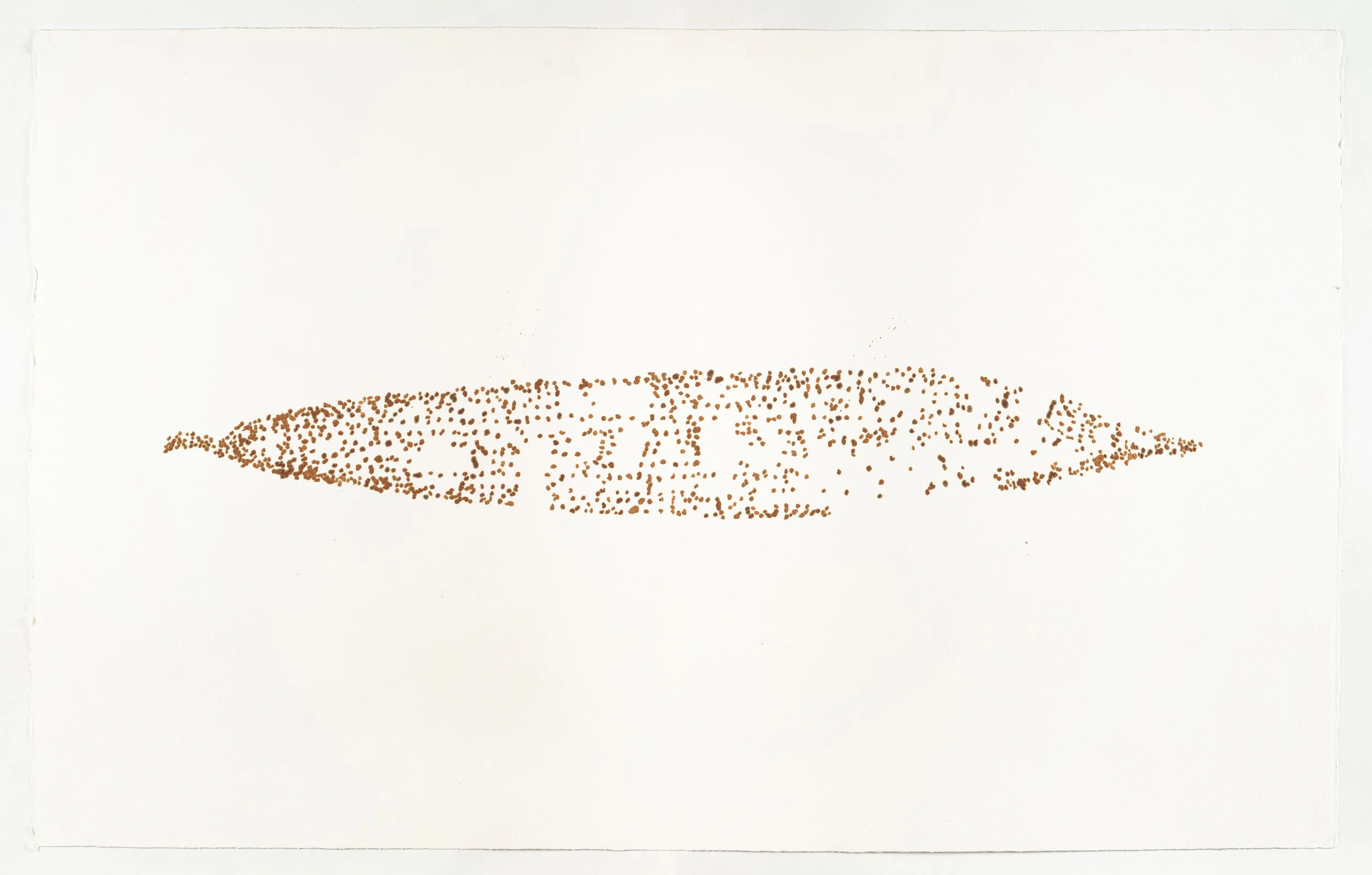
Brown Paper Bag Money, 2026
graphite pencil, Prismacolour, coffee on Arches Paper, 58 x 56 cm
My practice explores nostalgia, memory and the visual language of everyday Australia. Through realism, I document familiar places and cultural objects that are often overlooked yet deeply embedded within our collective identity. I’m interested in how ordinary things hold emotional weight, acting as vessels for personal histories, shared experiences and a broader sense of belonging.
This large-scale drawing of a school lunch order bag revisits a familiar yet forgotten object from Australian childhood. Once part of the daily ritual of ordering lunch from the local deli, the humble paper bag evokes memories of primary school, handwritten orders and the anticipation of lunchtime.
At the core of my practice is storytelling. I’m drawn to the way seemingly insignificant details can preserve fleeting moments and connect individual experiences with a shared cultural memory.
Through my work, I hope to elevate the beauty found in the everyday and contribute to a broader conversation about contemporary Australian identity and cultural memory. Each work and new series becomes another chapter in my future retrospect archiving Australia’s shared history.
Image courtesy of Brenton McGeachie
Purna Ratna Bajracharya, Melbourne, 1978, 2026
charcoal, 76 x 56 cm
Attending the funeral of my godfatherer, Frank Beormans, who firmly told me during the early years of my fatherhood, “I will not hear a bad word about your father” (Purna), I came across a black and white photograph of him I’d never seen. It was in a much-loved photo album, sheathed behind an air-bubbled, reflective and abraded mylar sleeve. The photo was taken before I was born on his first trip to Australia, where he, Frank and Margaret (Mum) were establishing a new shopfront for their venture importing Nepali crafts and art. I really wanted a copy of the photo and in the moment, shied away from asking if a reprint was possible and so, attempted a discrete digital capture with my phone through the air bubbles, fingerprint smudges, abraded and reflective mylar. It was a poor effort to document but with the editing tools available on my roadworthy iPhone 4s, I managed to hold onto the general details and vibe of the original photograph. Somewhere in that process, the lacking details and wanting the original photograph and settling for its doctored substitute, spoke volumes of my family history, my relationship with a father, who I love and am proud of but was barely in my life due largely and in broad terms, to circumstance.
I believe this drawing holds that love and disconnect. There’s effort in the detail but it’s blurred, smudged, portions of image are and out of focus.
Image courtesy of Brenton McGeachie
Fragments of Intention, 2025
CMY collage on board, 100 x 100 x 7 cm
Fragments of Intention is made from existing colour field works that carry minor imperfections. Rather than set them aside, I cut them by hand into strips, a slow and meditative process in which attention narrows to the blade and the rhythm of repetition.
The reconstruction is equally slow. Each strip is chosen by hand in response to the colours that came before it, then pasted down to the board one at a time. No strip is placed without reference to its neighbours, so the work grows through a chain of small decisions, each shaped by the last. In this way the process becomes a reflection on itself: a record of patience, attention and care.
Colour direction shifts according to the original work each strip was cut from. As these directions change across the surface, the work appears to move, an optical illusion heightened by the diagonally sloped directions of the top and bottom boards.
Through this reworking, flaws become material and fragments become a new whole, with a line emerging from the meeting of colours. The work proposes that intention is not fixed at the moment of making, but continues to be shaped in the slow act of putting things back together.
Image courtesy of Brenton McGeachie
Entanglement of Thought, 2026
graphite on washi paper, 200 x 69 x 3 cm
Entanglement of Thought explores the intangible experience of remembering and creates a visual language through drawing to reveal the paths in one’s past, present and future. Guinevere Isla is a multidisciplinary artist born in the Blue Mountains and now living in Naarm/Melbourne; she completed a BFA at National Art School (2023) and an MFA at RMIT (2026). Guinevere’s practice utilises drawing, printmaking and installation to reveal and understand one’s perception of memory and the act of remembering itself. Capturing the twists and tangles of sliced paper, Entanglement of Thought navigates the almost impossible task of untangling past experiences and visualising one’s internal world.
Image courtesy of Brenton McGeachie
Quiet reason 1, 2026
watercolour, gouache on rag paper, 57 x 76 cm
This work is part of my series Reason, which explores the scope of reason in the production of artwork: its purpose, its traces, its meanings, and the justifications that allow the work to come into being.
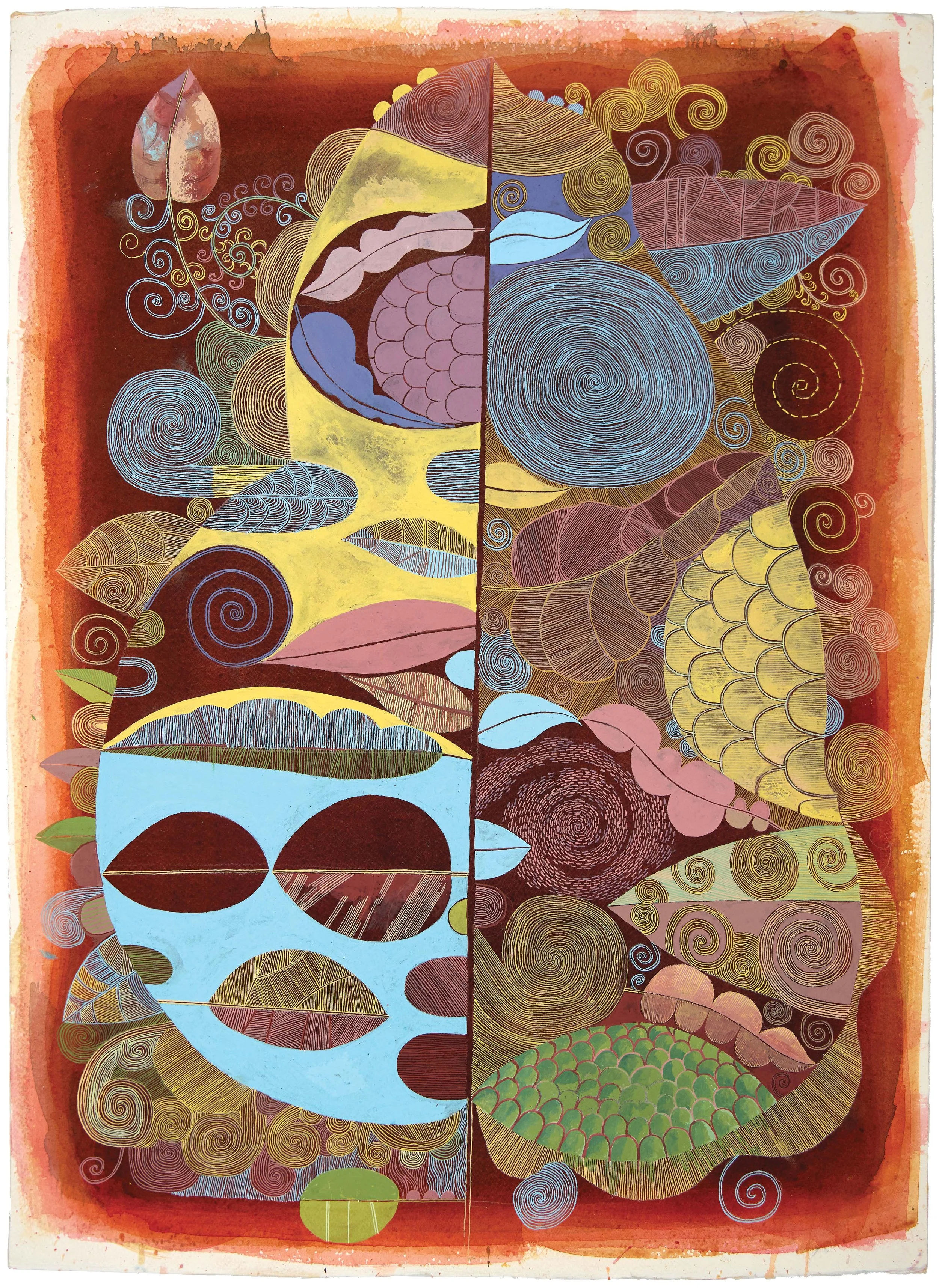
The series refers back to my previous body of work, 500 Leaves, which represents 500 years of my paternal and maternal family lives. Each leaf signifies a year in the lives of those who came before me, marking the passage of time and the accumulation of lived experience across generations.
The purpose of Reason was to continue working through the repetition of the leaf mark, using it as a means of building, questioning, and exploring the turbulence of life. Each mark is temporary yet purposeful, holding a moment of intention while contributing to a larger and evolving whole. Through this process, I explore the relationship between repetition and change, order and uncertainty, and the individual mark and the collective pattern.
The accumulation of marks becomes a way of constructing and exploring patterns as a means of creating structure of a leaf. Within this structure, meaning is not necessarily predetermined but emerges through the act of making itself. The work becomes both a record of time and a reflection on the reasons we continue to make, the traces we leave behind, and the ways in which we seek to give form and meaning to our experiences.
Image courtesy of Andrew Sikorski
Homage to von Bismarck [Quarry], 2026
kiln formed glass, 14 x 45 x 31 cm
Closely referencing Julius von Bismarck’s Landscape Painting (Quarry) (2021), where he physically paints black lines onto the rock faces of an abandoned volcanic quarry in Lanzarote, this work considers how line reveals space, and how the act of tracing the landscape is both a means of understanding and intervention.
The work echoes the visual language of sixteenth century copperplate engravings, though the illusion of form is not simulated by the hand but created through the transformation of the material itself. In the palpitating oscillation between two dimensional and three dimensional, the glass becomes the carrier of line, recalling topographical mappings and geological strata, folding and undulating into a terrain of its own.
It presents a moment suspended between drawing and sculpture, and considers the relationship between representation and physical experience, where the landscape is no longer something merely observed or depicted, but something materially reconstructed and encountered within our own space and time.
Image courtesy of the artist
Placemats, 2025
crocheted wire tapestry, 151 cm x 31 cm each
Gina Corridore is an artist whose research-led practice examines womanhood, culture, and belonging. Through needlework, she explores histories of women’s domestic labour while preserving connections to her Italian and Maltese heritage. Her work Placemats features a diptych of tapestries painstakingly and intricately crocheted from copper beading wire and iron binding wire, a material choice that seeks to reify the labour demand required for the work’s production, drawing the audience into conversations surrounding histories of women’s invisibilised domestic labour.
The crochet pattern has been recontextualised and adapted from antique 1910s filet crochet pattern books which typically featured imagery connoting visions of essentialised womanhood. The imagery was derived from a placemat pattern that has been extended dramatically to reflect the distinction between recorded hours of waged labour versus domestic labour where hours fuse into one never-ending and unfathomable shift. This also transforms the making process into a performance of endurance, whose ultimate labour and time demand can only be speculated upon by the audience, alike a woman’s unrecorded working hours in the home.
The harshness and brutality of the material combined with the durational labour, counted only by stitches as markers of time, seeks to challenge notions of domestic and reproductive labour as a desire inherent in the nature of women, a ‘labour of love’. Rather than, as posited by feminist scholar Silvia Federici, an intentional structuring of labour hierarchies along gendered lines within a capitalist framework. A structure that renders domestic labour as unwaged, undervalued, and unbargainable.
Image courtesy of Brenton McGeachie
The Offing #21, 2026
pencil, metallic watercolour, Karst stone paper, 21 x 13.2 cm
The offing is that part of the sea that can be seen from the shore, just before the horizon – at a distance but within sight. It is also a term for what is in the near or foreseeable future.
One view, seen over a period of days. The offing is the point of interest; it disappears and re-emerges. At times it is indecipherable, a convergence of sky and sea.
Change is accumulating. Predictions of change emerge from our observations: the colours of the sky at the sun’s first rise, at midday and at setting; blue skies bleached white by a hot, hot sun; the colours of our oceans, a constantly changing array of hues.
The drawings sketch this repeated experience – an amalgam of day-after-day observation. The urgent mark-making reflects a growing cognisance of the unstable state of our world.
Image courtesy of Brenton McGeachie
Muruwari granddaughter, 2024,
Eucalyptus bark, fibre, botanical-dyed silk, quandong seeds, emu feathers, 170 x 125 x 5 cm
I tread softly on the Country of my grandmother’s birth. Her father was born in the brown earth of the muruwari birthing tree. A tree that knows us. Generations were born here and walked and thrived; a place of remembering. I turn in a slow circle, my own kids in tow. I sit at the meeting place of the 5 tribes. The ancient guruwa (gum trees) sing and dance by the mighty Barwon River. I watch the lines drawn in Country that circle me and remember the lines on my grandmother’s hands, as my own hands work the woven fibres. The Elders in the circle chatter as the river birds ready for evening and the guruwa leaves under me have pressed, and imprinted on my bare legs.
Muruwari Granddaughter is a deeply personal work that incorporates weaving, carving, drawing, and Native plant printmaking. The contemporary landscape draws on ancient Aboriginal traditions of painting on bark but rethinks the practice in new ways that acknowledge my cultural connectedness to land and sky, home and family.
Image courtesy of Brenton McGeachie
Sea Cow, 2026
pen and acrylic on paper, 54 x 77 cm
"It's a Sea Cow!"
The reaction from one of my children upon first seeing the work on the dining table. This sums up why I love abstract work and automatic drawing in particular, which continues to be the core focus of my practice. The viewer can use their imagination to interact with the drawing, following the gestures, shapes and forms to inform their experience.
All of my drawings begin in the same way. Once pen is put to paper, the mark making begins with a deliberate attempt to avoid considered figures and representations. This work has the more recent addition of acrylics, painted in the same automatic way, the initial drawing provides a framework for new organic shapes to develop.
"They're seeds"
"No, it's rain!"
"I think that one is toast"
Image courtesy of Brenton McGeachie
Implied freedom, 2026
charcoal, pigment ink, pen, oil on canvas, 120 x 76 cm
Implied Freedom explores the tension between freedom and constraint through a chaotic composition of fragmented and discombobulated forms. The work presents an unsettled visual landscape in which movement, vulnerability and uncertainty are contained within a crisp, defined border. The contrast between the disorder within the drawing and the controlled edge surrounding it suggests the conflicting forces of freedom and restriction, reflecting the ways in which individuals navigate personal and social limitations. Through expressive mark-making and layered forms, the work conveys a sense of instability while maintaining a deliberate sense of containment.
Image courtesy of Brenton McGeachie
Better than television, 2026
ink, pigment, medium on plywood, 42 x 100 cm
Better than television draws on the motif of the screen to offer a wry alternative to passive visual consumption. The oval base echoes the geometry of a screen or portal with the black forms disrupting any expectation of clarity or narrative. Instead of broadcasting images, the work invites active engagement. The geometric forms act as a type of mapping; a pull towards something more elemental, an internal architecture.
Better than television refuses to entertain. It asks the viewer to engage in closer looking — to inhabit ambiguity, to consider what is obscured, and to recognise that meaning often emerges from what resists being shown.
Image courtesy of Brenton McGeachie.
People No.3, 2025
mild steel, 92 x 127 x 3 cm
Rmsina Daniel is an artist concerned with figuration and the human form. Daniel was always interested in the human condition as she firmly believed that the human is the central figure of this world.
Daniel is a sculptor capable of working with a different range of materials. Her practice begins with drawing from a coffee cup seeking figures, then further extended through sculpture. Daniel has been working continuously with steel for 6 years. Her residency at the Sydney Olympic Park Armory allowed her to further her skills in welding. Usually, the environment and the site form the scale of her sculptures. Most of Daniel’s works are abstract relief sculptures and involve installation and composition that reveals a certain truth.
Image courtesy of Brenton McGeachie
Maggie softly, 2026
cotton thread, antique silk, fabric scraps, 23 x 27 x 0.5 cm
Sewing, like drawing, is both noun and verb; an action and object. The continuous line of thread is a fuse, capturing tension, form and philosophically explosive.
The Maggie series is inspired by my three great great great Irish grannies. They would have used this mending technique to extend the life of a garments elbows, knees and collars. Fabric scraps are layered and disciplined with running stitch. Clothes could then last for generations. Many children wearing through the patches. Stitches and the spaces between hold love, care and resilience. The continuous line is the story of time passing. The stitch strains in its purpose to hold firmly, the disparate elements that are otherwise lost.
Stitchwork plays with drawing processes; colour, composition, texture and tone. Yet the drawing is extended into radical object, expressing feminist and political dissent.
Image courtesy of Brenton McGeachie
Firefly, 2026
graphite on paper, 28.5 x 28 x 0.1 cm
In my piece Firefly, I wanted to capture the quiet resilience of the human spirit. For my subject I chose my friend Celia, who consistently carries a positive energy, regardless of circumstance.
Her expression holds a subtle melancholy and emotional depth, overshadowed by hope and inner strength. She looks off into the dark unknown while her face remains illuminated, glowing against the dark background.
The modern world feels increasingly uncertain. New technologies and rising isolation question our resolve and what it means to relate to one another.
I wanted to capture the light within each of us that remains a counter to these forces, and Celia embodies exactly that.
Unknown to either of us at the time the reference images were taken, Celia had just begun the process of becoming a mother and I hope this portrait has helped capture that moment of new life.
Image courtesy of Brenton McGeachie
Viking Grave, 2026
spent ferric chloride on pierced Hahnemühle, 50 x 75 cm
Earlier this year I visited the grave of a Viking King, buried in his ship 1000 years ago. All that remains is the hundreds of iron nails that held the ships wooden planks together. The nails trace the shape of the once proud hull.
The Latin word punctum means a prick or point. Roland Barthes uses the word punctum in Camera Lucida to mean that aspect of a photograph that wounds and pierces you. All that remains of this ship is the punctum. I made this work by piercing the paper along the schema of the nails, as mapped by the archaeologists who unearthed it 100 years ago. I added a drop of ferric chloride, saturated in copper and now exhausted, to each hole, filling it with iron oxide. This work follows on from recent work about the dead ships in the Aral Sea and the mythology of Charon the ferryman, ferrying the souls of the dead to the Underworld.
Image courtesy of Stephen Best
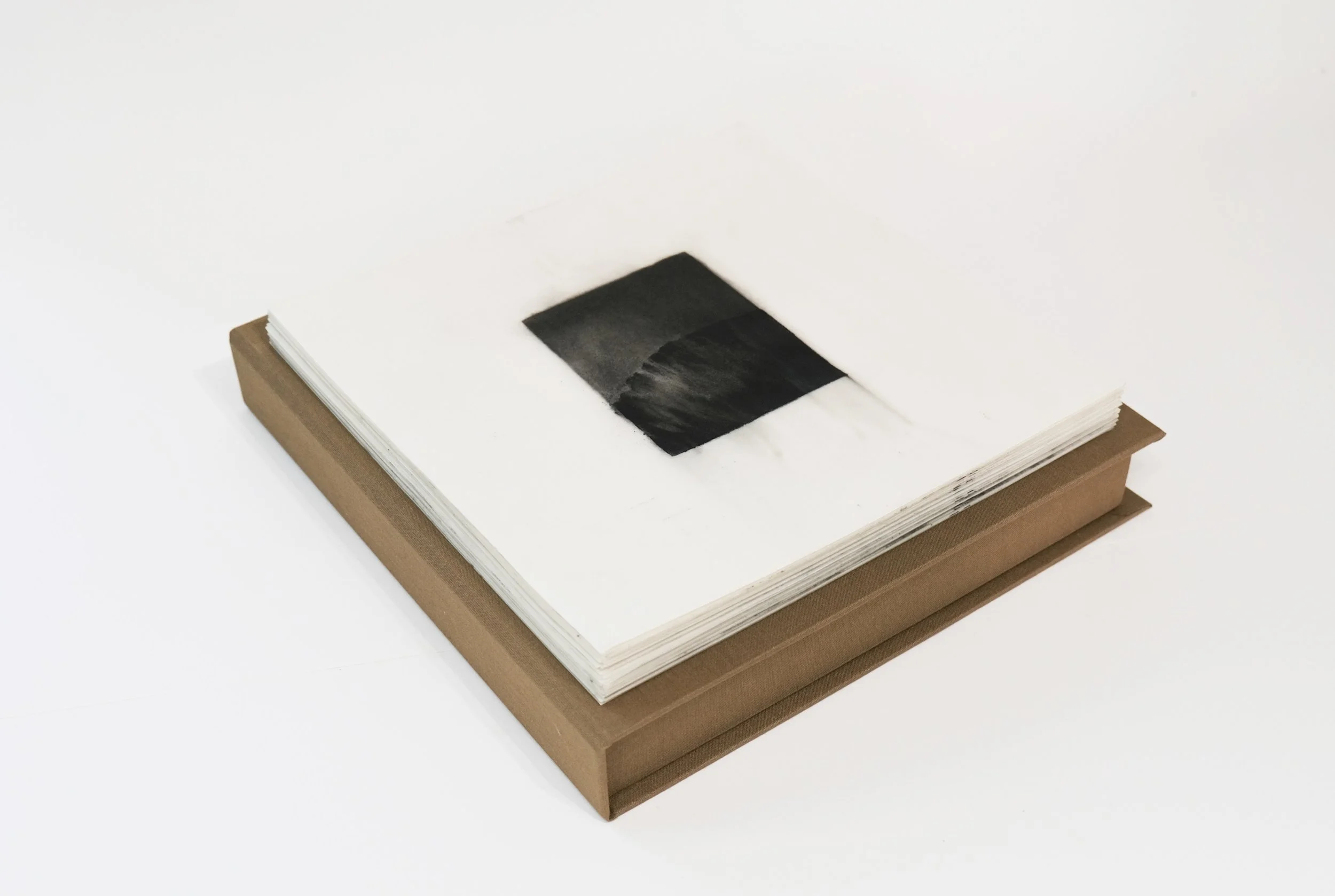
dunmoochin, 2024
50-page artist book with loose-leaf drawings encased in wax, charcoal, found pigments, artist-made Solander box with inlaid wax drawing, 26 × 26 × 5 cm; video, 00:05:01
For 18 months, I returned to the same view, watching, listening and drawing the slow changes in the landscape seen from my studio window at the Dunmoochin Foundation, an artist community on Wurundjeri-willam Country (Cottles Bridge, Victoria). Set up high in the trees, I witnessed a place in constant motion. The light shifted, the trees swayed and the earth moved in rhythms familiar and precarious.
Each drawing, of which there are 50, is made with charcoal and sealed in beeswax. They are small windows into this impermanent place. The wax acts as both a shield and a skin, preserving what is fleeting, holding this dusty place before its blown away.
This artist's book documents a visible landscape but also the quiet tension of place on the edge of change, where the sky burns gold one moment and brims with a foreboding force the next. Every shift here, in light or in the wind, hums with anticipation of what is to come. The fear of what has been has never left.
Image courtesy of the artist
Afterimage, 2026
bushfire charcoal, chalk and ash on paper, 60 x 40 cm
Kim Anderson applies the broader human experience of grief and mourning as a theoretical framework to examine climate-related loss, ecological grief, and solastalgia.
This drawing contains charcoal and ash collected from a fireground after the devastating January 9th bushfires that occurred on Dja Dja Wurrung country, a day of extreme heat, wind, smoke and apocalyptic skies. The gritty unforgiving quality of working with these mediums conjured up the destructive power of the inferno that reduced bushland and homes to ash. Making this work became a struggle between Anderson’s habitually meticulous drawing process, and the uncontainable forces of the natural world to which we are completely vulnerable.
The ghostly image of foliage is like an afterimage on the retina after a flash of bright light, and as the climate crisis escalates and engulfs us, all we may be eventually left with are smoke, ash and memories.
Image courtesy of Brenton McGeachie
Coalescence 1, 2025
graphite pencil on Yupo paper, 57.5 x 90 cm
Coalescence #1, is part of a body of work of five, where the artist Nadège Lamy is observing patterns and fractals created by nature, in her practice she often asks herself how is it possible to be so perfectly harmonised in a world of nature chaos. She is inspired to understand the infinitely intricate shapes of self-similarity in which the smallest parts resemble the whole.
Nadège Lamy is curious to reflect on order and chaos around us and in us and to offer a space to breathe.
Image courtesy of Brenton McGeachie
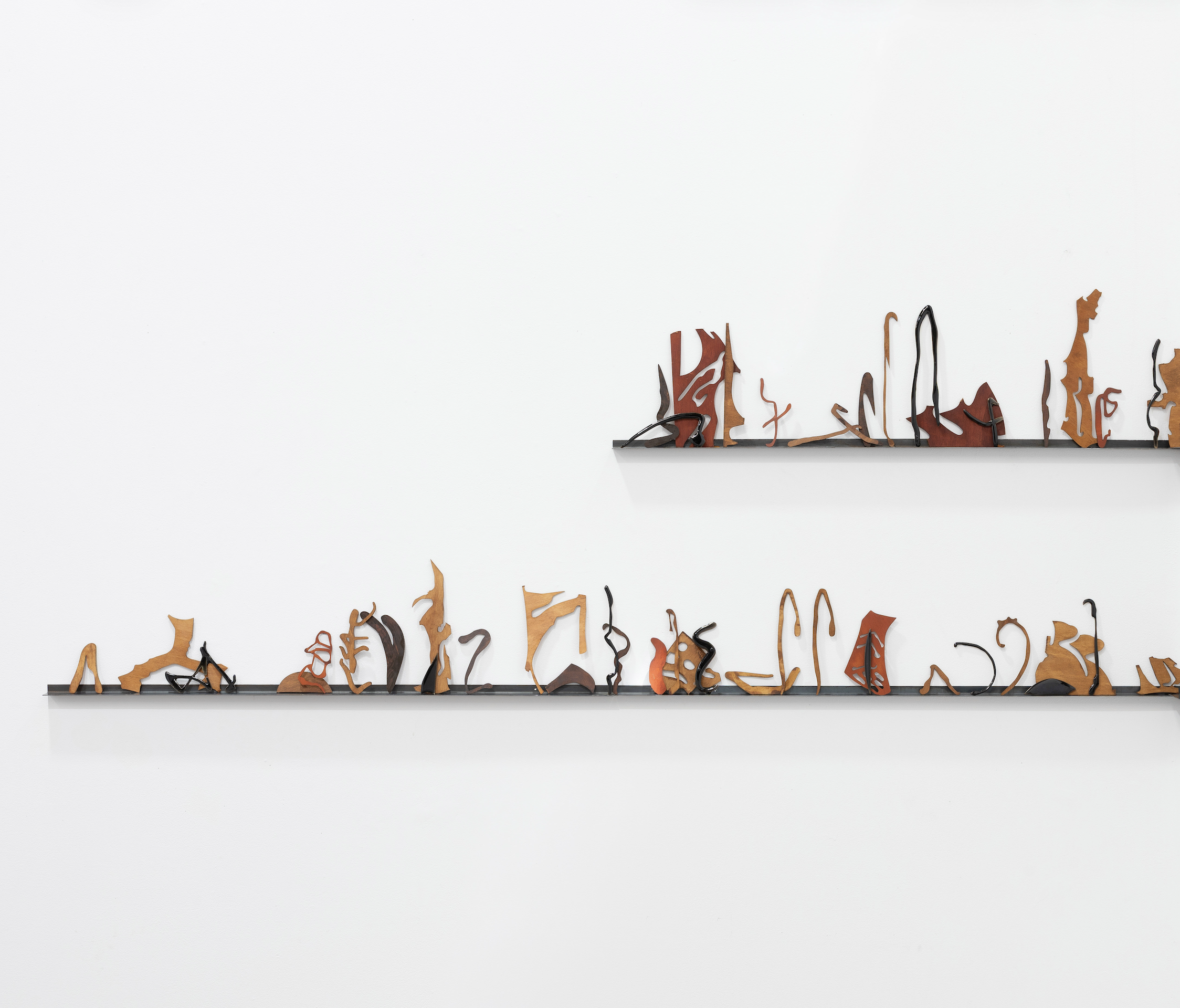
Misreading Misreading, 2025
stained plywood, epoxy, pigment, mild steel, 80 x 200 x 3 cm
Challenging assumptions that graffiti is merely “a kind of angular, syncopated writing that no longer says anything at all,” (as Jean Baudrillard once wrote), Misreading Misreading centres a less conventional conclusion regarding graffiti and its apparent meaninglessness: that somehow, in all its nothingness, it still says, ‘I exist somewhere’.
In this work, graffitied forms are collected then combined with the material logic of a nineteenth-century printing press: they are recast in wood; stained; ‘inked’; and arranged along steel shelves that mimic a typesetter’s composing stick. This stages a tension between graffiti’s covert impracticality as a legible script, and a technology whose sole purpose is to disseminate clear, neutral, and ‘reliable’ information from authorities that control what is believed, who is believed, and whose voice is allowed to be heard.
Since city walls have long functioned as spaces for voices not otherwise ‘permitted’ to speak, graffiti presides as the disseminating voice for the voiceless—sanctioned or unsanctioned, language or non-language. And whilst Madden’s work often explores the poetic potential of the illegible, here, she instead considers how graffiti’s anonymity and unreadability is precisely what makes it legible. Because what it says, even when it says nothing at all, is that in this city, somebody exists somewhere—and that ‘somebody’ can be a harbinger of change not through language, but simply by being witnessed.
Image courtesy of Jessica Maurer
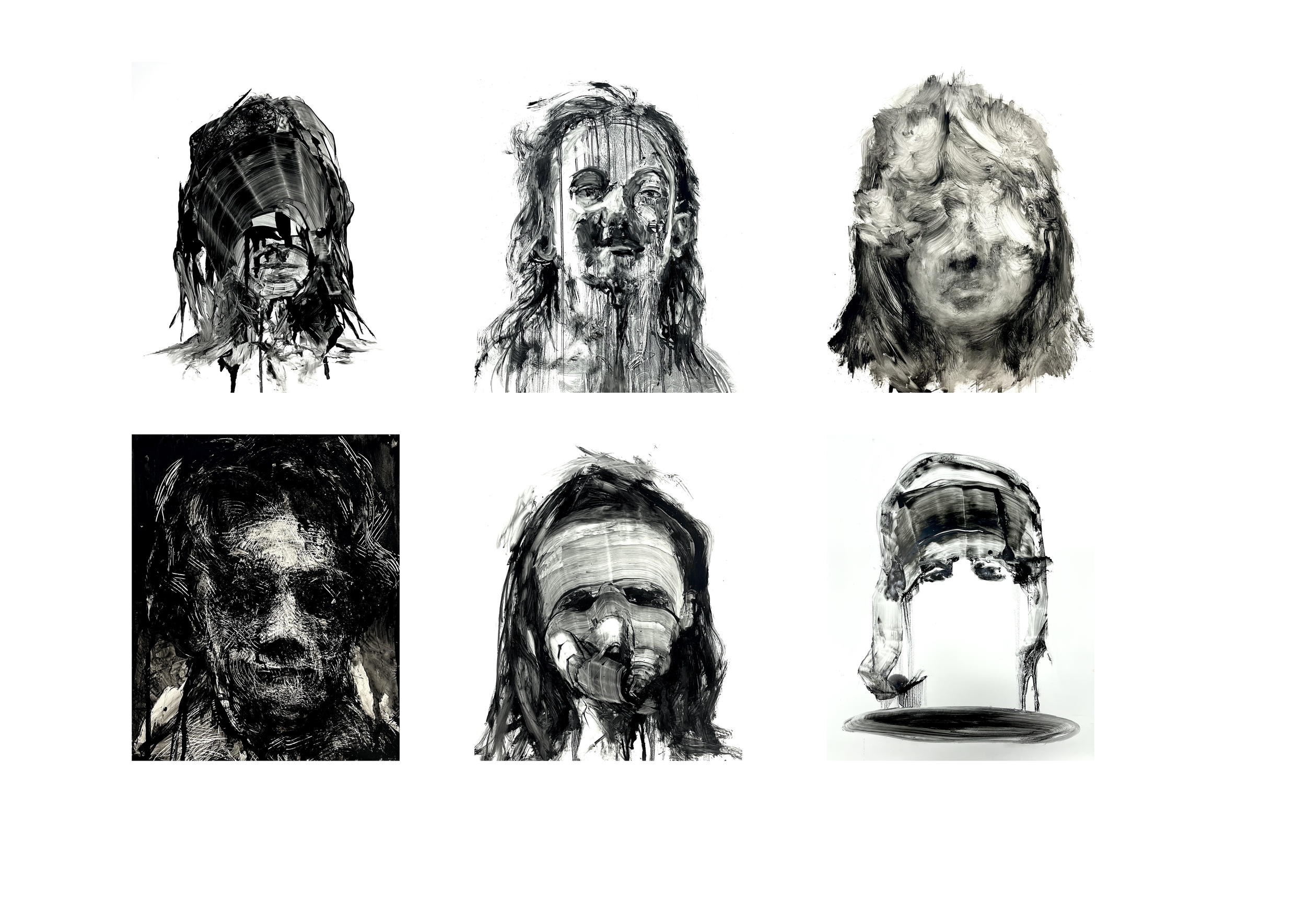
The Making of a Person, 2026
ink, oil, acrylic, chinagraph pencil, charcoal on synthetic paper, 75 x 100 cm
The Making of a Person considers the human figure as something unstable, continually constructed, obscured and remade by forces within and outside us. Memory, desire, fear, temperament and imagination act from within; love, family, culture, institutions, violence and chance act upon us from outside. Over time these distinctions blur: what happens to us becomes part of us. The drawings mirror this process. Each figure emerges through accumulated acts of marking, wiping, obscuring and reconstruction. Marks are made, altered and removed, while traces of what came before remain. Like the people they depict, the drawings become the product of what has happened to them.
Image courtesy of the artist
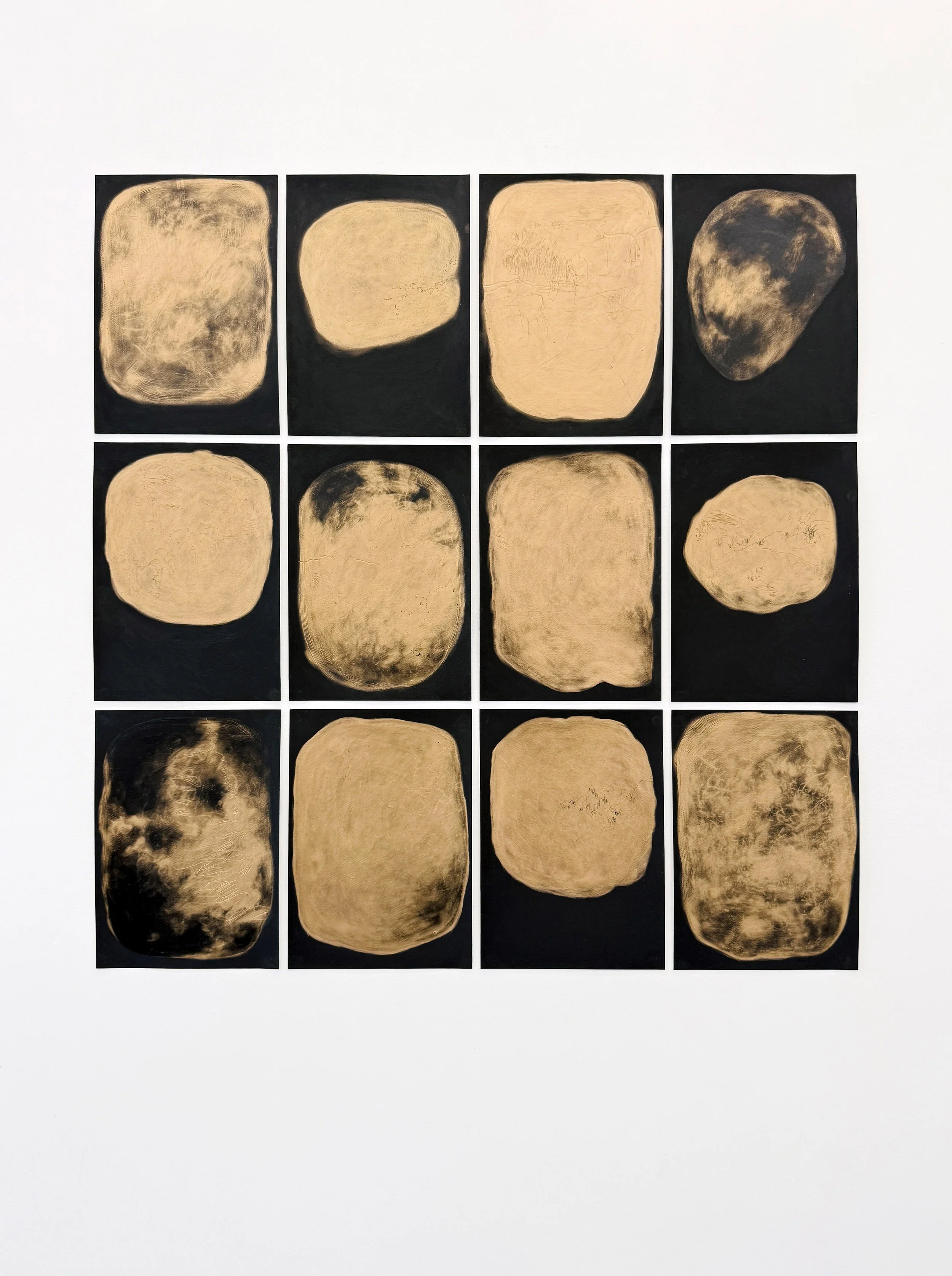
World-making while walking, 2026
beeswax, blackboard paint, gold pigment on 300 gsm paper, 106 x 103 cm
As we move through time and space we perceive through the body, through the activity of the senses. Whether consciously or unconsciously, what we sense also influences how we feel. In the daily flow of actions and reactions, our lived experiences are idiomatic, however, the boundaries at which the inner and outer worlds meet are the same.
I chose soft beeswax on paper as a proxy for the body’s membranes, the surfaces on which impressions are made and perceived. I made drawings by cutting, scraping and scratching into the beeswax while walking; the mark-making is unmediated and automatic. Each drawing is a single walk with a beginning and an end. I don’t look at the drawing while walking, I wait until the walk has ended to see what has been captured.
Image courtesy of the artist
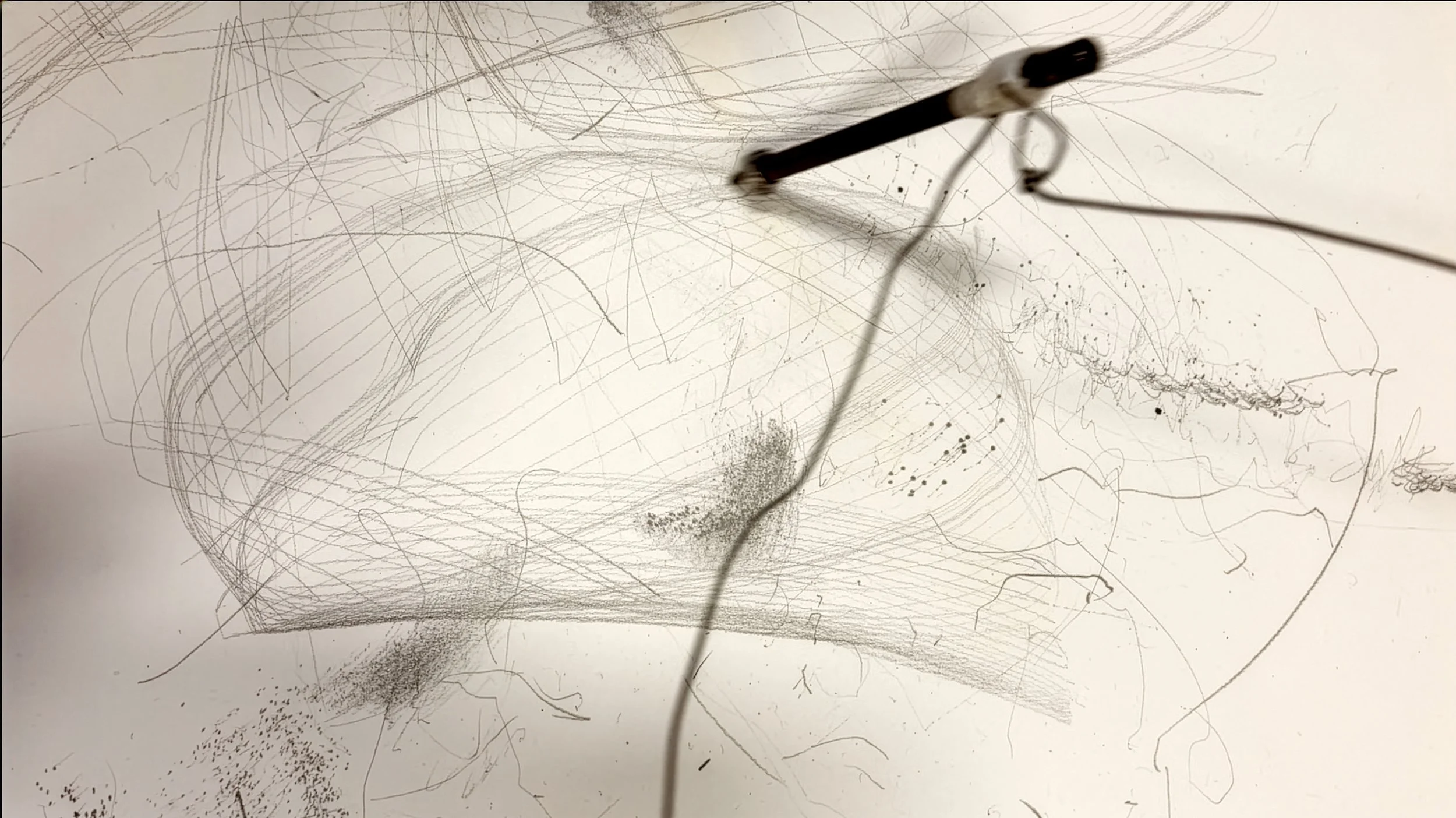
Drawing sound, 2026
installation, 80 x 110 x 20 cm
A substantial part of my drawing practice inhabits a category regarded as ‘expanded drawing’ — drawing that moves off the page and beyond its conventional boundaries.
This drawing machine is another experiment following on from previous explorations in which I have combined wire with two-dimensional drawing to create drawings that are partly sculptural. I have drawn directly onto my body and made costumes that combine drawing with movement, so that drawing occupies space, moves, performs and interacts with its surroundings.
In this work, a keyboard activates motors that move pencils across graphite marks on a sheet of paper. The pencils and graphite become part of an electrical circuit. As the pencils move across the graphite drawing, the resistance changes, producing an unpredictable and often chaotic sound.
The drawing is not simply an image produced by the machine. The marks on the page become part of a circuit that controls sound, while the sound and movement feed back into the drawing. The machine connects drawing, movement and sound, extending the drawing into a responsive and constantly changing system.
Image courtesy of the artist
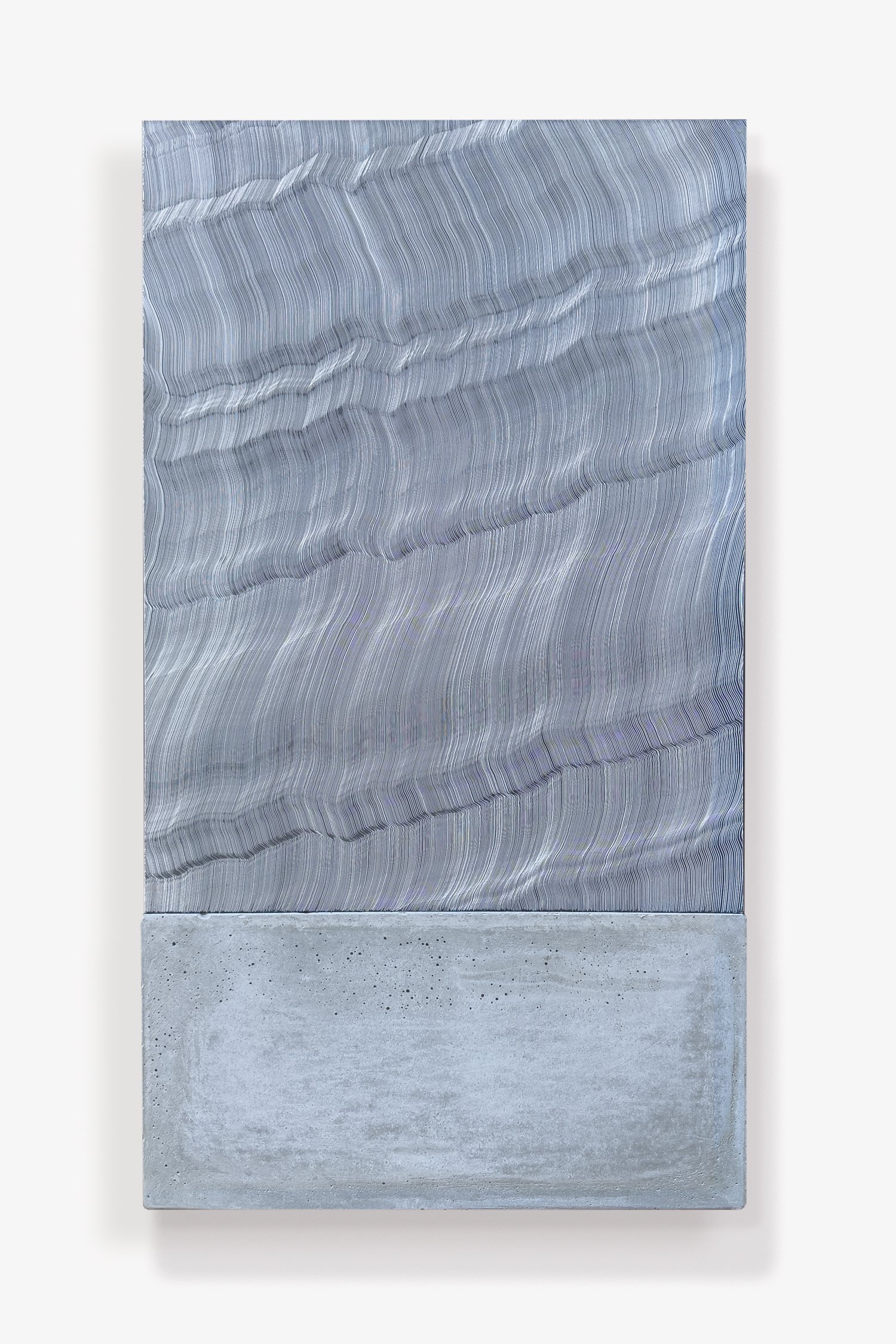
as if immersed, breath on skin, 2026
scratchboard, concrete, 56 x 31 x 4 cm
I draw lines as an act of presence and resistance.
The work begins with a profile line from a sandstone escarpment I found lazily dropping into Sydney Harbour. I retrace the profile-line using my breath as a metronome to weave embodied time with slow geological scales of memory and becoming. While making the work I try to stretch memory beyond the horizon of lived duration to invoke a kind of remembering.
The repetition in the work speaks to change, to a generative difference. And there, within each line is the rhythm of my body, where pressure and speed register the corporeal. I can see it, my breath in the work, a rhythm that quietly builds within the line and across multiple lines.
Image courtesy of the artist
Brown Hawk Messenger Bird, 2026
washi paper watercolours, posca pens, acrylic, 96 x 63 cm
Natalie Bateman is contemporary Yuin artist whose art practice is deeply connected to Country, ancestry, and cultural identity. With Walbanja-Yuin heritage, her work is informed by her family’s enduring connection to La Perouse, Maroubra Beach, and Gulaga on the Far South Coast of NSW.
Painting for more than three decades, Natalie creates vibrant works inspired by time spent on Country, translating the landscape through acrylic, watercolour, and Japanese inks. Her distinctive use of ancestral motifs, expressive colour, and organic forms reflects her deep respect for Country and celebrates the enduring strength of her culture.
Image courtesy of Brenton McGeachie
Moment In Time - 2nd Of March 2026, 2026
gouache, archival ink on paper, 70 x 70 cm
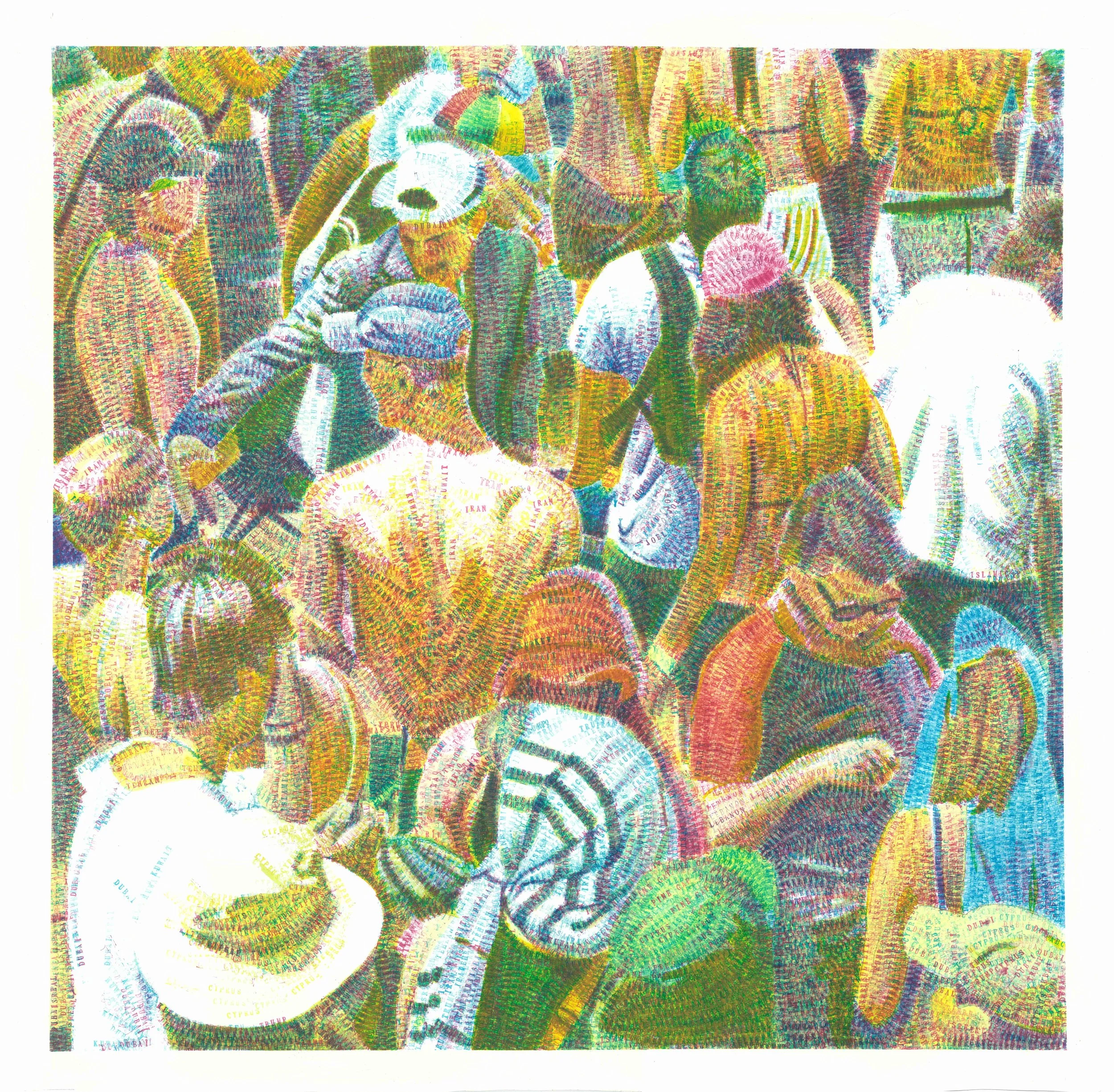
This artwork uses trending words as stamps in an impressionist style. In a data-driven world defined by data harvesting, mass surveillance, and the threat of climate collapse. My work captures the escapism of the dancefloor, depicting the duality of a complex world and the liberation of techno culture.
The piece originates from a moment I experienced at an Australian techno festival on 2 March 2026; that day, the US/Iran war had just started, and the Middle East region had become violent and unstable. At the festival, I recorded the top trending words on X in real time, then turned them into stamps and layered them to build depth, form, and light.
The artwork presents two dualities. Up close, you see the intrusive flood of global headlines; step back, and those words dissolve into a vivid human moment of shared freedom. Reflecting on how we preserve our humanity while living in a society of hyper-tension.
Image courtesy of the artist
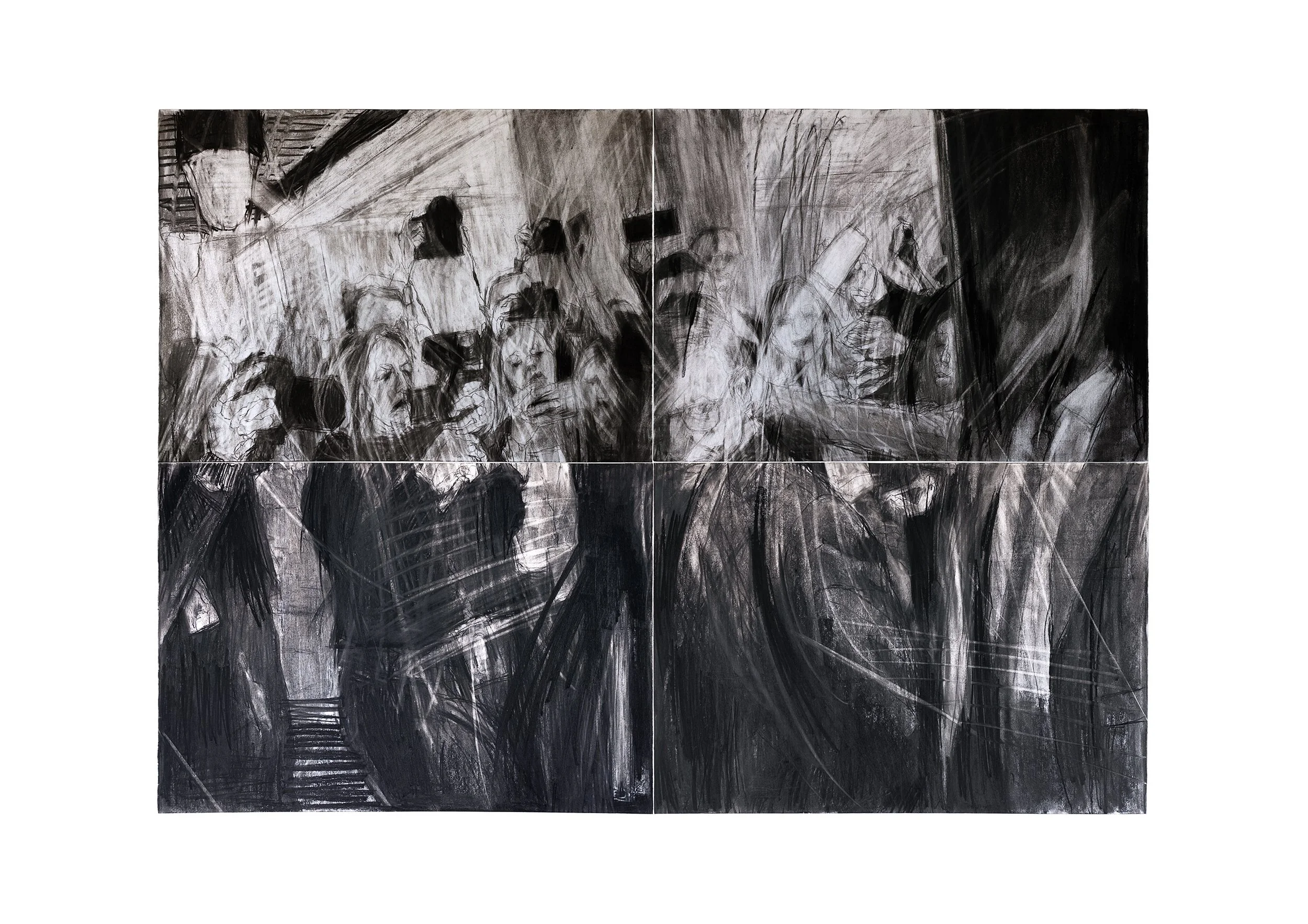
Interior hysteria, 2026
charcoal on paper, 112 x 152 cm
Interior hysteria is from a body of work that draws reference from Getty press images of media scrums. I am captured by the frenetic energy of the source material, emblematic of a self-perpetuating modern hysteria.
Usually I’m interested in capturing a sense of quiet or interiority in drawing. In this case, it is the absence of these qualities – a void of stillness.
My work explores the generative potential of drawing (as a verb). Approached as thinking-through-drawing, my working process holds space for investigation, paradox and doubt. I work with materials that reflect my thematic concerns – paper, charcoal, wax, light – mediums that inherently reference shifting states, unfixedness, and sensitivity to the surrounding environment.
Image courtesy of the artist
where never cloud abides, 2026
graphite on paper, correction fluid, pins, corkboard, 64 x 48 x 5 cm
where never cloud abides is a diptych composed of two UV-exposed bulletin boards, with each displaying one graphite drawing.
Having had these panels since I was thirteen, the work explores the passing of time and memory through the sun’s accumulated tanning on postcards, magazine clippings, and stickers. The resulting rectangular marks reveal the outlines where materials were once layered and when I doodled as a teen with Wite-Out.
The illustrations depict a royal christening and porcelain pheasant—subjects and objects commonly found in regional museums, many of which I visited following a recent residency in Murringo. Together, this overlay on the bulletin marks the passing of my citizenship test, examining how cultural relics form national identity.
Image courtesy of Brenton McGeachie
Sundae Best, 2026,
coloured pencil on paper, 60 x 42 cm
Sundae Best is about the way childhood memories seem to grow sweeter with time. Issey-Harmony Utama wanted to capture the excitement of a classic diner sundae and how something so ordinary could once feel like such a special treat.
Rendered slowly in coloured pencil, the sundae is already beginning to melt, leaving small traces of the moment behind. The time-intensive process of drawing contrasts with the fleeting nature of the subject: something that would ordinarily disappear within minutes is instead carefully preserved on paper.
Through this process, Utama gives an everyday object the same time and attention we often give to the memories attached to it, exploring the way nostalgia can preserve, soften and sweeten otherwise ordinary moments.
Image courtesy of Brenton McGeachie
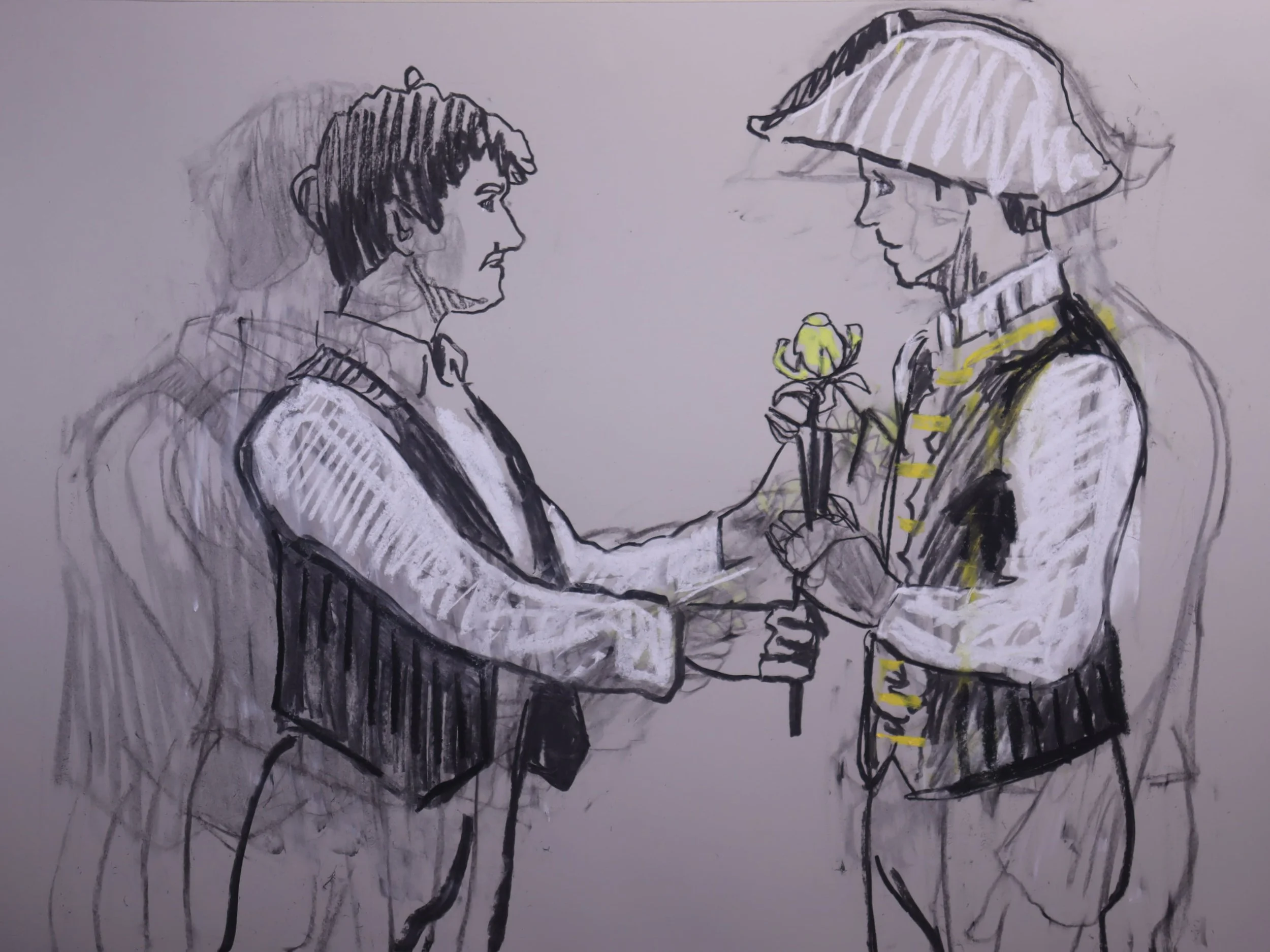
Camp with Me, 2025
digital video, chalk, charcoal and acrylic animation on paper, archival material, 00:03:51 minutes
Camp with Me imagines a queer romance between William Lygon, the 7th Earl of Beauchamp and 20th Governor of New South Wales, and poet Henry Lawson. When outed, Beauchamp was exiled to Europe after King George V remarked, “I thought men like that shot themselves.” Blending archival material, ballroom dance, video and hand-drawn animation, the work slips between fact and fantasy, rumour and romance. At its centre is a waltz, choreographed with queer ballroom company Lead and Follow, allowing Beauchamp a moment of queer love. The work imitates and uses archival materials while reframing national icons through humour and desire. In this work drawing is a tool for reframing the past and imagining alternate queer futures.
With thanks to Mathew Nicholson (Lead and Follow) and Shae Mountain.
Audio track features the voice John Doremus from the radio series The Passing Parade produced by Grace Gibson Productions. Full series available from GraceGibsonRadio.com. Courtesy the National Film and Sound Archive, Australia.
Image courtesy of the artist
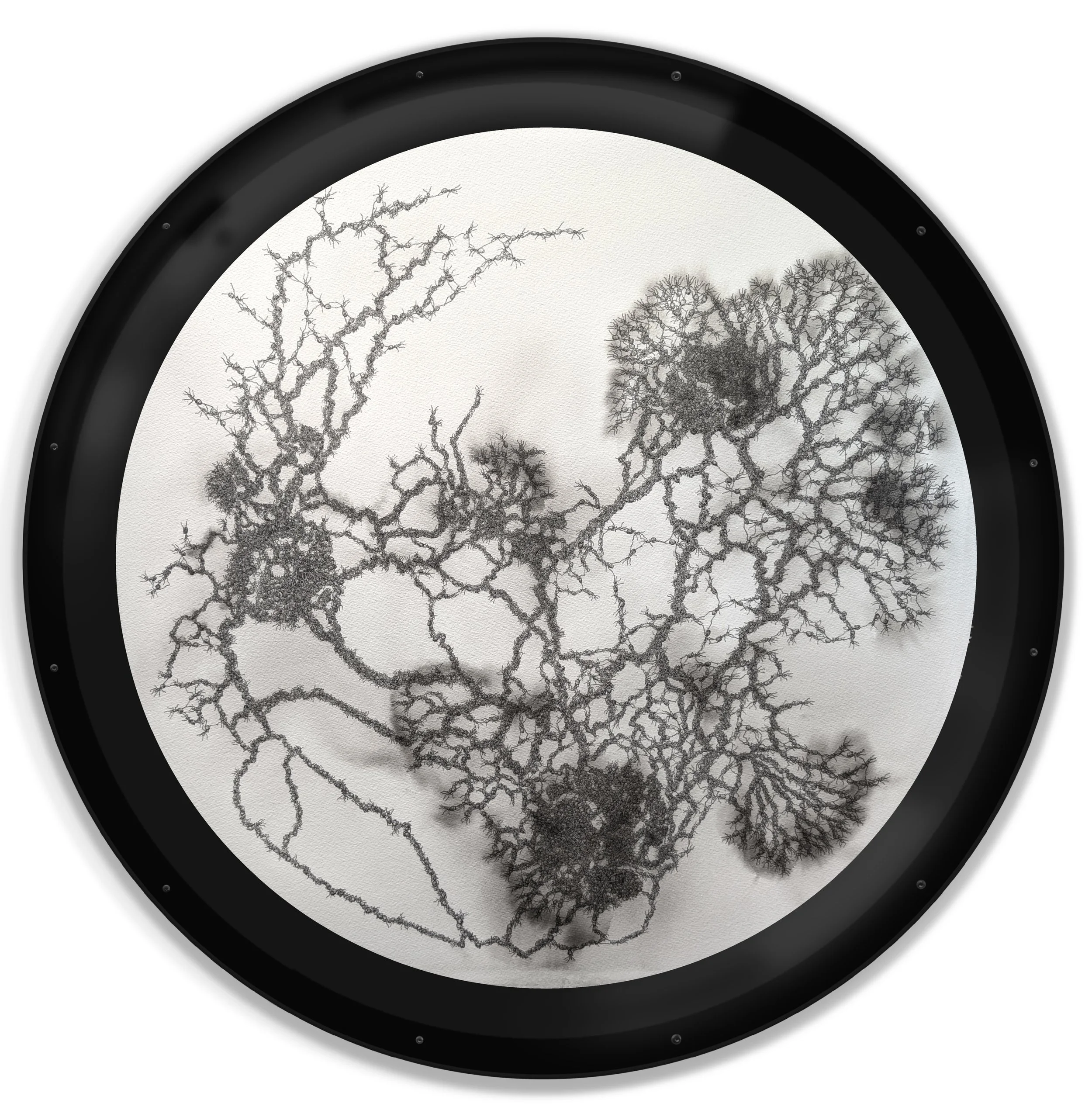
More than the Sum of Parts, 2026
pen and ink on paper, 90 x 90 x 4 cm
Humans coined the word ‘intelligent’, hence, we are intelligent, if not modest. Each ant is simple, a few legs, a few lines, and probably can’t fathom the emergent intelligent behavior of a whole supercolony - but neither can I. Each cue, interaction, behavior is multiplied and magnified until a complex intelligent system emerges. 2842 ants, drawn by an ape, trace out a pattern made by a plasmodium in a Petri dish. These humble lifeforms map their space, communicate and collaborate, adapting to their changing internal and external worlds in a way that can only be called ‘intelligent’. Slime molds and supercolonies can’t wax lyrical about ontology, but they show our species what it means to be more than the sum of our parts.
Image courtesy of the artist